
倒数第二次恋爱
让退役军人获得感、幸福感、安全感成色更足_我的网站

A |
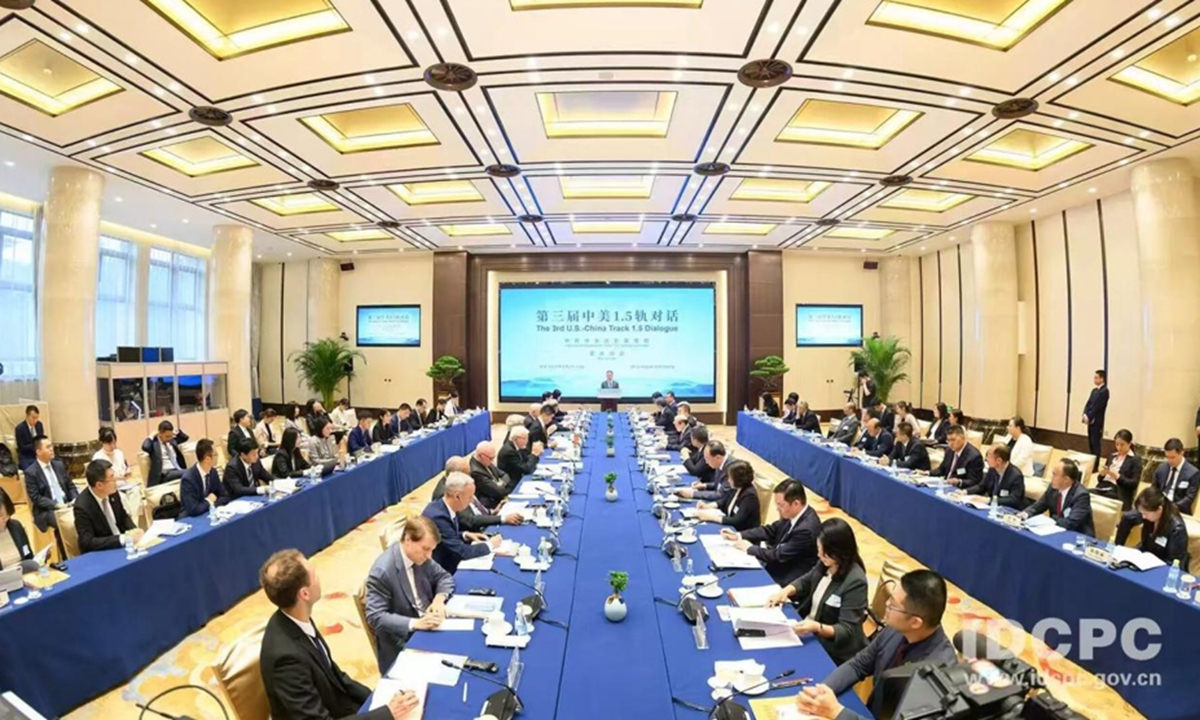
The third China-US Track 1.5 Dialogue was held in Beijing on Tuesday, bringing together government officials, scholars and business representatives from both countries for discussions on constructive strategic stability and practical cooperation.
Co-hosted by the International Department of the Central Committee of the Communist Party of China (IDCPC) and the Asia Society, the dialogue was attended by about 40 representatives. Participants included officials from relevant Chinese government departments and local governments, experts from think tanks and universities, as well as figures from US strategic and business circles, including John L. Thornton, co-chair of the Asia Society Board of Trustees.
Under the theme "Constructive Strategic Stability - Practical China-US Cooperation in the New Era," the participants held candid, in-depth and constructive exchanges, according to the IDCPC's release on its WeChat account on Tuesday.
Addressing the dialogue, Liu Haixing, head of the International Department of the CPC Central Committee, said the two sides have recently followed the direction set by the two heads of state, taken practical steps to strengthen communication and dialogue, advanced a positive agenda and achieved notable results.
Liu called on the two countries to continuously enlarge common interests and make cooperation the anchor of positive stability. He urged the two countries to uphold mutual benefit and reject zero-sum games so that competition remains within bounds, to seek common ground while managing differences, and observe the bottom line of no conflict and no confrontation to achieve lasting peace and stability.
Participants discussed ways to enhance political mutual trust, expand economic and trade cooperation, and explore cooperation in artificial intelligence, science and technology, CCTV News reported.
Established in 2023, the China-US Track 1.5 Dialogue operates between formal government-to-government diplomacy, known as Track 1, and purely nongovernmental exchanges, known as Track 2. The second dialogue was held on June 13, 2024, during which participants held candid, in-depth and constructive exchanges around the theme of "sharing perspectives and finding solutions on key and urgent issues."
As a channel involving both government and nongovernmental participants, the Track 1.5 mechanism can help China and the US communicate more effectively, identify common ground and better understand the consensus reached by the two heads of state, Zhou Mi, a senior research fellow at the Chinese Academy of International Trade and Economic Cooperation, told the Global Times on Tuesday.
It can also help translate the consensus into greater mutual understanding and concrete action, Zhou said.
Discussions on AI at this year's dialogue could help the two sides identify shared interests despite existing frictions and technological challenges, creating opportunities for practical cooperation and laying the groundwork for follow-up efforts, he noted.
Wang Yiwei, a professor at the Renmin University of China's School of International Studies, told the Global Times on Tuesday that the Track 1.5 dialogue serves as a bridge between Track 1 and Track 2, allowing participants to discuss sensitive issues and explore policy space while conveying frontline assessments and feasible proposals to decision-making departments.
Liu outlined practical pathways for China-US cooperation in the new era. First, the two sides should uphold mutual respect, peaceful coexistence and win-win cooperation, steer China-US relations to overcome the "Thucydides Trap," and create a new paradigm of major-country relations.
Second, the two countries should jointly shoulder their responsibilities as major powers, make constructive interaction an important driver of international cooperation, address global challenges together and inject greater stability into the world, Liu noted.
Third, they should expand exchanges and cooperation in trade, public health, agriculture, tourism, people-to-people ties, law enforcement and cooperation between localities, thereby strengthening the resilience of bilateral relations and working toward a better future, Liu said.
Overcoming the "Thucydides Trap" fundamentally rejects the notion that conflict between major powers is inevitable, Wang Yiwei said. It reflects an effort by China and the US to pursue a path different from the historical confrontation between an established power and a rising one.
Such a model does not seek to avoid competition altogether, but to ensure that competition has boundaries, differences remain manageable and cooperation retains sufficient space, Wang Yiwei said.
To put this approach into practice, the two countries should respect each other, avoid crossing red lines concerning core interests and reduce the risk of strategic miscalculation. They should expand areas where their interests converge and establish regular cooperation mechanisms on global issues such as climate change, public health, food security and AI safety, turning shared responsibilities into joint action, he noted.
As the world's two largest economies, China and the US should recognize that many global challenges cannot be effectively addressed without coordination between them, particularly at a time of intensifying competition. Constructive engagement is therefore not a temporary expedient but a long-term responsibility that major countries should undertake for the world, Wang Yiwei said.
The dialogue came a day after China's top political advisor Wang Huning met with US delegates attending the event in Beijing on Monday.
During their meetings, the US side said that the US-China relationship is at a special juncture, adding that the sound rapport between the two heads of state constitutes the most valuable and important part of bilateral ties. The US side agrees that both sides should act on the consensus of building a constructive US-China relationship of strategic stability, advance corporate cooperation, expand people-to-people and cultural exchanges, guard against risks such as those posed by artificial intelligence, and deliver benefits to both countries and the rest of the world, according to Xinhua.
。 近年来,市退役军人事务局深入学习贯彻习近平总书记关于弘扬雷锋精神的重要指示精神,践行新时代雷锋精神,锚定“尊崇军人职业,尊重退役军人”目标,推动退役军人工作高质量发展。

B | 突出服务优先,打造雷锋先锋服务窗口 市退役军人事务局坚持服务保障退役军人“五有”原则,全市建立市、县、乡镇、村四级退役军人服务中心(站)961个,实现服务保障退役军人组织架构全覆盖,服务站设立接待窗口、退役军人活动室,开展政策咨询、思想宣传、困难申请、光荣牌优待证申领发放等工作;建立退役军人微信群,将服务的主动性从窗口延伸到线上,提升退役军人业务办理便利性。 加强优待抚恤,坚持普惠优待叠加原则 市退役军人事务局以优抚对象为服务保障重点,累计发放各类优抚资金1.8亿余元;解决部分退役士兵社会保险问题,为8000余名退役士兵补缴保险1.1亿余元,为退役军人提供有力的民生保障。积极争取优待政策,广泛开展退役军人建档立卡和优待证申领发放,累计发放优待证6.8万余张。目前,全市有103个景区和服务机构为现役军人、退役军人和三属提供优惠优待。 聚焦民生底线,解决退役军人就业难题 市退役军人事务局坚持就业优先战略,积极开展岗位推荐和政策宣传,为退役军人搭建就业平台,组织专场招聘、直播带岗和就业扶持活动20余次,提供就业岗位10000余个,达成就业意向1500余人次。努力提升退役军人就业能力,累计为300余名自主就业退役士兵开展职业技能培训,为700余名退役士兵办理复学和提升学历教育。

C | 坚持党建引领,扎实开展志愿服务活动 市退役军人事务局积极开展“岗位学雷锋 领航实好干”活动,与共建社区联合开展志愿服务10余次,有力促进机关和基层党建双促进。

D | 充分发挥“党建+退役军人”架构作用,倡导退役军人党员共同参与退役军人工作,先后成立退役军人志愿者队伍13支、村(社区)服务站志愿服务队121支,退役军人党员亮明“身份”、勇作“表率”、争当“先锋”,积极参与走访慰问、乡村振兴、基层治理、典型事迹宣讲等活动。先后有20余名退役军人和退役军人工作人员被选树为国家、省、市级“模范退役军人”“最美退役军人”,在全市退役军人中起到了思想引领作用。 营造尊崇氛围,维护退役军人合法权益 市退役军人事务局坚持以问题为导向,践行“枫桥经验”,在市信访大厅专设退役军人接待窗口,累计接待退役军人2000余名,化解退役军人信访问题1000余件,重复信访案件和“万件化访”专项行动案件化解率100%。开展入户走访和帮扶援助2300余人,推动信访矛盾实现“事心双解”。市退役军人局成立以来,先后有4个部门和3名同志获评市直机关“岗位学雷锋”示范典型。 抚顺市退役军人事务局党组书记、局长孟庆光说:‘市退役军人事务局深入学习贯彻习近平总书记关于弘扬雷锋精神的重要论述,深刻把握雷锋精神的时代内涵和实践要求,将“岗位学雷锋 领航实好干”主题实践活动与做好当前退役军人事务重点工作、坚定不移推动高质量发展结合起来,在服务强国强军、提高服务保障水平、防范化解风险上展现新担当新作为,实现把退役军人“接收安置好,服务保障好,教育管理好,作用发挥好,权益维护好”目标,为打好打赢全面振兴新突破三年行动攻坚之战、奋力推进中国式现代化建设贡献退役军人事务工作力量。’ 责任编辑:李丹。
Current article:http://nhpphfk.qixicuorenchouzuan.buzz/list_11nu34/bmoif.html
Published on:13:45:23


